1
/
of
1
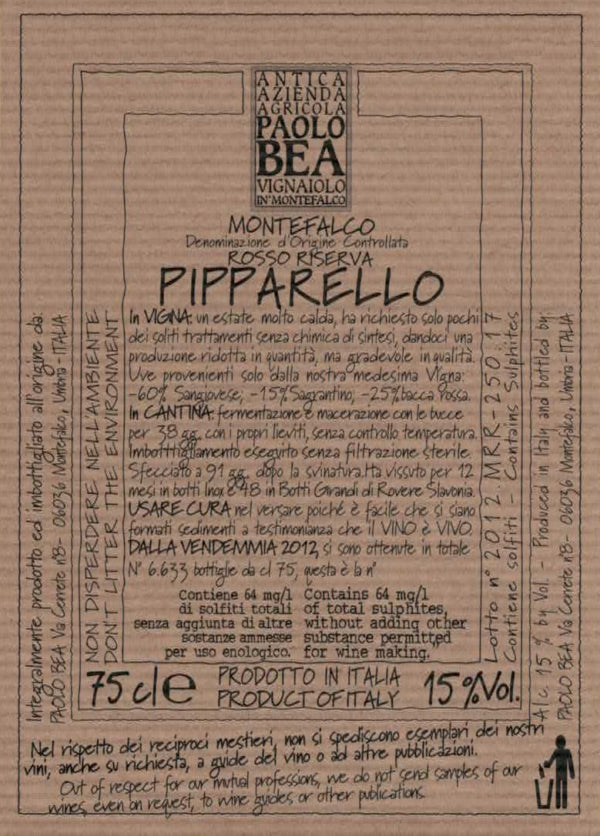
Paolo Bea Pipparello Montefalco Rosso Riserva - 2019 (750ml)
Regular price
$104.99
Sale price
$104.99
Regular price
$119.99
Unit price
/
per
Shipping calculated at checkout.
Youthfully intense, the 2019 Montefalco Rosso Riserva Pipparello smolders up with a hauntingly dark bouquet of grilled herbs, cloves, flowery undergrowth and dried black cherries. This mixes silken textures with a wonderfully graceful feel, showing vividly pure red berry fruits and a cascade of spices, all offset by a tinge of sour citrus. This puckers the cheeks with concentration and a coating of fine-grained tannins, finishing structured yet with immaculate balance and poise. Rosy inner florals and sour cherry resonate. The Pipparello is always a standout for me from the Bea portfolio, perfectly blending 60% Sangiovese, 15% Sagrantino and 25% Montepulciano. Bury the 2019 deep in the cellar. - By Eric Guido on August 2024
Share :

- varietal
- Region
- Sub - Region
- Type
- Reviews

Product Review
The 2005 Montefalco Rosso Riserva Pipparello is a rock star wine. This powerful, intense red emerges with generous dark cherries, plums, licorice, smoke and leather. The late harvest in 2005 resulted in an extraordinarily complete wine blessed with tons of pedigree. The 2005 Pipparello is 60% Sangiovese, 25% Montepulciano d’Abruzzo and 15% Sagrantino. The wine saw 42 days of contact on the skins and was aged for a year in stainless steel followed by two years in cask. Simply put, it is magnificent! Anticipated maturity: 2013-2025.
Product Score
94
Sagrantino is one of the most tannic varieties in the world, and creates wines that are inky purple with an almost-black center. The bouquet is one of dark, brooding red fruits with hints of plum, cinnamon, and earth.
Area in Umbria Italy where Sagrantino
Red wine is wine made from dark-coloured grape varieties. The color of red differs based on the grapes variety or varieties used.Interestingly, black grapes yield a juice that is greenish-white. The actual red color comes from anthocyan pigments (also called anthocyanins) from the skin of the grape (exceptions are the relatively uncommon teinturier varieties, which produce a red colored juice). Most of the production centers around the extraction of color and flavor from the grape skin.