1
/
of
1
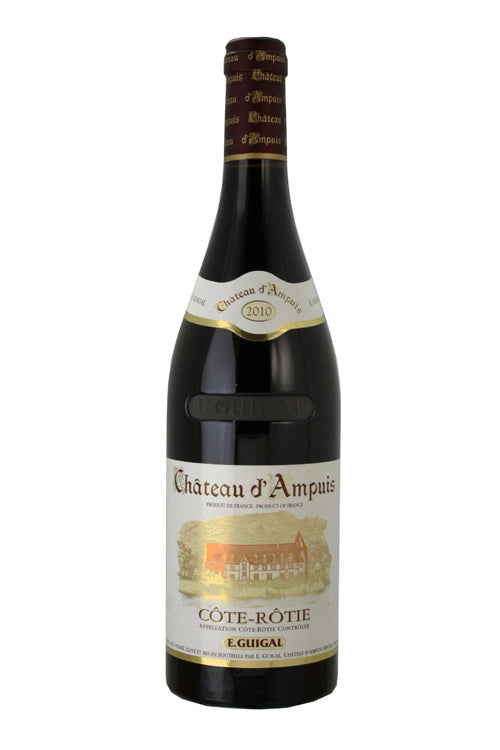
Guigal Cote-Rotie d'Ampuis - 2010 (750ml)
Regular price
$199.99
Sale price
$199.99
Regular price
$229.99
Unit price
/
per
Shipping calculated at checkout.
More closed than when I tasted it earlier this year, the 2010 Cote Rotie Chateau d’Ampuis is an incredible effort that’s made from 93% Syrah and 7% Viognier. Coming from the estate’s top sites and aged 38 months in new oak, it has no problem standing beside the top three single-vineyard releases. Crème de cassis, vanilla bean, smoked meats and licorice all flow to a full-bodied, beautifully concentrated, structured Cote Rotie that needs another 5-6 years of bottle age, but will keep for 2-3 decades.
The father/son team of Marcel and Philippe Guigal continue to keep their estate at the top of the hierarchy in the Rhône Valley. All the way from their inexpensive Côtes du Rhône to their top-end Côte Rôties and Hermtiage, the attention to detail and focus on quality is unmatched. Readers should also check out the recent Rhone Retrospective article I wrote that covered the Saint Joseph Vignes des Hospices, Côte Rôtie Brune et Blonde, Côte Rôtie Chateau d'Ampuis and Côte Rôtie La Mouline cuvees going back for over a decade. I said it there, and I'll say it again here, this estate is producing some of the most incredible and singular wines in the world.
Wine Advocate - 99 points
Share :

- varietal
- Region
- Type
- Reviews

Product Review
More closed than when I tasted it earlier this year, the 2010 Cote Rotie Chateau d’Ampuis is an incredible effort that’s made from 93% Syrah and 7% Viognier. Coming from the estate’s top sites and aged 38 months in new oak, it has no problem standing beside the top three single-vineyard releases. Crème de cassis, vanilla bean, smoked meats and licorice all flow to a full-bodied, beautifully concentrated, structured Cote Rotie that needs another 5-6 years of bottle age, but will keep for 2-3 decades.
The father/son team of Marcel and Philippe Guigal continue to keep their estate at the top of the hierarchy in the Rhône Valley. All the way from their inexpensive Côtes du Rhône to their top-end Côte Rôties and Hermtiage, the attention to detail and focus on quality is unmatched. Readers should also check out the recent Rhone Retrospective article I wrote that covered the Saint Joseph Vignes des Hospices, Côte Rôtie Brune et Blonde, Côte Rôtie Chateau d'Ampuis and Côte Rôtie La Mouline cuvees going back for ov
Product Score
99
Depending on where it's grown and how it's made, the variety has two names. In France, where it goes by Syrah, it makes a huge contribution to the red wines of the Rhone Valley. In the southern Rhone villages of Chateauneuf-du-Pape, Gigondas, and Vacqueyras it is blended with a number of varieties but mainly Grenache. It is in the northern Rhone, including Hermitage, Crozes-Hermitage,Côte-Rôtie, St. Joseph, where it most often stands out on its own, and is only occasionally blended with the region's white grapes. More recently, in the late 20th Century, Shiraz has put Australian producers such as Penfolds and d’Arenberg on the fine wine map, with cult wines like "Grange" and "The Dead Arm". Generally speaking, the style from the old world is more savoury, expressing aromas of pepper, cured meat and leather. The hotter climate experienced in Australia results in more upfront, dense and even jammy fruit. The grape has also taken off with rapid success in California and Washington, as well as South Africa and New Zealand. Producers in these regions often name their varietal wines according to the style they intend.
The Rhone is one of France’s most important wine regions. Divided into two separate zones, the north is probably the most prestigious. It is home to the appellations of Condrieu, Côte Rôtie, St. Joseph, Hermitage, and Crozes-Hermitage. Syrah is king with the exception of the Condrieu (100% Viognier) and Hermitage, which also makes big whites from Marsanne and Roussanne. The South is a much larger region where most Cotes du Rhone and Cotes du Rhone Village come from. In the villages of Châteauneuf-du-Pape, Gigondas, Vacqueyras, and Rasteau, Syrah is blended in varying proportions with Grenache, Mourvedre, Cinsaut, and a host of obscure varieties such as Muscardin, Vaccarese, Terret and Counoise, to produce full-bodied reds brimming with energy.
Red wine is wine made from dark-coloured grape varieties. The color of red differs based on the grapes variety or varieties used.Interestingly, black grapes yield a juice that is greenish-white. The actual red color comes from anthocyan pigments (also called anthocyanins) from the skin of the grape (exceptions are the relatively uncommon teinturier varieties, which produce a red colored juice). Most of the production centers around the extraction of color and flavor from the grape skin.