1
/
of
1
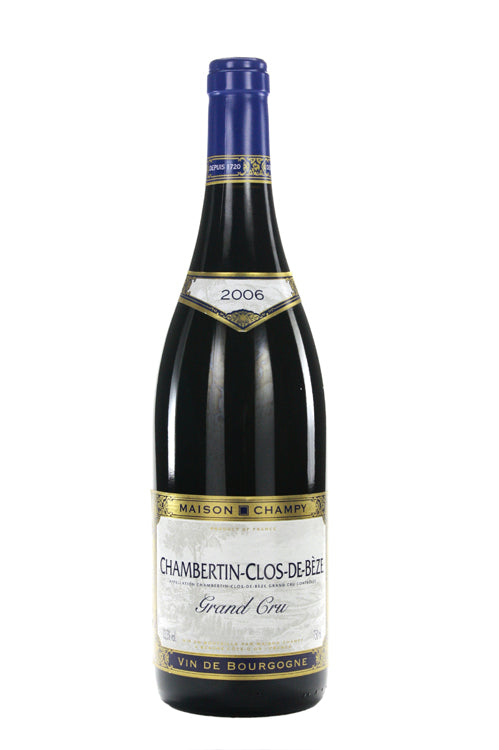
Champy Chambertin-Clos de Beze Grand Cru - 2006 (750ml)
Regular price
$199.99
Sale price
$199.99
Regular price
$229.99
Unit price
/
per
Shipping calculated at checkout.
Producer note: As has been detailed in these pages before, winemaker Dimitri Bazas and director Pierre Meurgey are making real progress in their efforts to change the style of the reds toward less structured and more accessible wines without losing the essential spirit of Maison Champy as having crafted several centuries worth of vins de garde (age worthy wines). Champy has long been famous for wines that improve for years and then last for decades, indeed I have had wines deep out of the 19th C that are still in fine shape. However, as Meurgey told me two years ago, "our clients want more accessibility earlier. So after much debate, we've decided to modify somewhat our approach to build wines that should mature, at the top levels, over a 10 to 20 year horizon rather than 50. To that end we are no longer doing a post-fermentation heating of the must and are lowering the percentage of new wood. Still, we are not throwing the baby out with the bath water as it were because we're continuing with some wines to retain 15 to 20% of the stems [and in some cases, 50%], which is hardly a commercial approach in the region today. We're also going to continue with a longer than average élevage period of 16 to 18 months. And I want to emphasize that these changes are essentially stylistic, not qualitative." Like most négociants buying a wide range of grapes and/or wines in 2006, the quality here was mixed with some excellent wines and some that were less inspiring. If you haven't tried the Champy wines since the 2005 vintage, I would suggest taking another look. You will still find them to be quite serious but perhaps not quite so formidably young as in the past. (Diva Beaune, Beaune, France - diva@planetb.fr; Jeroboam Wines, New York, NY; Agent - Pol Roger and Haynes, Hanson & Clark, UK).
Tasting note: The nose here is fascinating as it's a mix of elegant spicy cranberry, herb and forest floor aromas where the latter element is picked up by the supple, forward and almost easy middle weight flavors that lack the same depth of material as the best wines in the range. To be sure, this is a solid wine but it just lacks the same overall complexity and power that one expects from a top flight Bèze.
Burghound - 90 points
Share :

- varietal
- Region
- Sub - Region
- Type
- Reviews

Product Review
Producer note: As has been detailed in these pages before, winemaker Dimitri Bazas and director Pierre Meurgey are making real progress in their efforts to change the style of the reds toward less structured and more accessible wines without losing the essential spirit of Maison Champy as having crafted several centuries worth of vins de garde (age worthy wines). Champy has long been famous for wines that improve for years and then last for decades, indeed I have had wines deep out of the 19th C that are still in fine shape. However, as Meurgey told me two years ago, "our clients want more accessibility earlier. So after much debate, we've decided to modify somewhat our approach to build wines that should mature, at the top levels, over a 10 to 20 year horizon rather than 50. To that end we are no longer doing a post-fermentation heating of the must and are lowering the percentage of new wood. Still, we are not throwing the baby out with the bath water as it were because we're continuing with some wines to re
Product Score
90
Pinot Noir is responsible for some of the world’s finest wines. Famed for producing the red wines of Burgundy and the Côte d’Or in particular, it is now widely grown in cool climates across Califonia and Oregon, and with increasing success in New Zealand. Although typically used to produce varietal wines, Pinot Noir makes a significant contribution in the wines of Champagne, where it is vinified as a white wine and blended with Cardonnay and Pinot Meunier. On the whole, fresh summer fruit of strawberries, raspberries and red cherries tend to be the identifying qualities, however richer versions express darker fruit including black cherries (kirsch), cherry cola, leather and violets to name a few.
Two hundred miles south east of Paris lies the famous and historic wine region, known in French as Bourgogne. The Cote d'Or, the heartland of the region, consists of two distinct sub-regions split on either side of the town of Beaune.The Côte de Nuits to the north, includes the famous villages of Vosne-Romanee, Gevrey-Chambertin, and Nuits-Saint-Georges and are known primarily for making red wine from Pinot Noir.Although The Côte de Beaune to the south still makes some magnificent reds (see Volnay and Pommard), white wine made from Chardonnay is the main focus. The most famous villages are Puligny-Montrachet and Meursault. Burgundy has three other important regions. The village of Chablis (exclusively Chardonnay) encompassing the region's most northerly vineyards. The Côte Chalonnaise and Mâconnais to south are quantitatively speaking more important. Agriculture is more diverse with a significant portion of the land devoted to livestock and arable farming.
With 400 hectares under vine and eight grand crus (more than any other village,) Gevrey-Chambertin is one of Burgundy’s largest but yet finest villages. Its wines are typically richer and firmer than neighbouring Chambolle-Musigny and Vosne-Romanée to the south. Gevrey’s grand crus are located together in one area at the southern end of the village bordering Morey-Saint-Denis. Chambertin, often considered the finest as with the region’s other great vineyards, is appended to the name of the village to which it belongs. Interestingly and perhaps by no coincidence, Chambertin shares a very similar soil make-up to the equally famous white wine vineyard - Le Montrachet – in the Cote de Beaune’s, with an almost identical proportion of two thirds fine earth and one third pebbles. Adjoining Clos de Beze and Chapelle just below are also considered to be just as fine, but are slightly different in style, offering more delicacy and sometimes more complex wines. Some of the villages premier crus, such as Clos St-Jacques and Cazetiers in the north west corner of the commune, are often sold for just as much the grand crus, and are quite justifiably priced. The village level wines also vary depending on where they come from. Those to the north have more grip and strength, while the southern climats tend to me more fragrant. In this instance, blending of the different vineyards allow more flexibility in producing a more complex and balanced wine.
Red wine is wine made from dark-coloured grape varieties. The color of red differs based on the grapes variety or varieties used.Interestingly, black grapes yield a juice that is greenish-white. The actual red color comes from anthocyan pigments (also called anthocyanins) from the skin of the grape (exceptions are the relatively uncommon teinturier varieties, which produce a red colored juice). Most of the production centers around the extraction of color and flavor from the grape skin.